How to recycle old solar panels and batteries? The answer begins with safety, not the recycling bin. Solar panels contain valuable glass, aluminum, silicon, and wiring, but some older models may also contain hazardous materials. Batteries require even greater care. Damaged lithium-ion units can overheat, ignite, or release harmful substances when crushed or punctured. Do not dismantle them at home.
A reliable process starts with identifying the equipment, checking its condition, and contacting the manufacturer, installer, or an approved recycling facility. A qualified technician can separate working panels for reuse and direct damaged units to specialized treatment. Batteries should be stored in a cool, dry place, away from metal objects and combustible materials. Use insulated packaging when a certified provider requests transport. Never place batteries in household waste or ordinary recycling containers.
The process is not always neat. Some recycling programs accept panels but not storage batteries. Others serve only specific regions. That detail matters. Local requirements, manufacturer instructions, and facility certifications should be verified before moving anything. Recycling professionals typically document the equipment type, serial information, condition, and final destination. This record improves traceability and reduces accidental disposal.
A practical guide should also acknowledge uncertainty. Recycling technology is improving, yet recovery rates and accepted materials vary. Reuse may sometimes create more value than immediate material recovery. However, unsafe storage can quickly cancel those benefits. Careful handling protects people, prevents fires, and keeps useful resources in circulation.
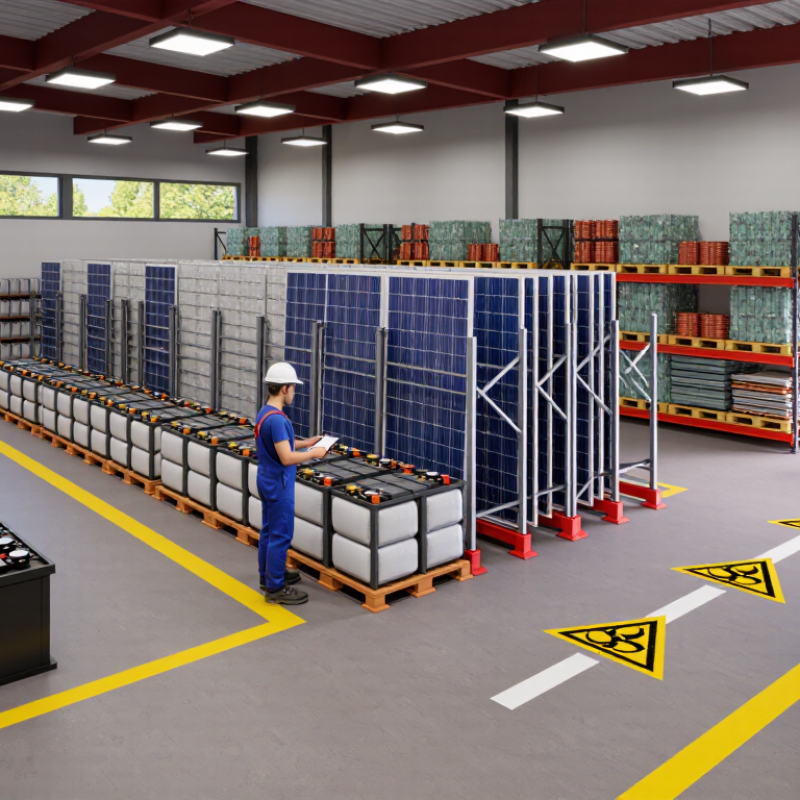
Solar panels and batteries look recyclable, but their internal mixtures make ordinary sorting unsafe. A panel is not only glass. It also contains silicon cells, aluminum frames, copper wiring, polymers, solder, and small amounts of valuable metals. Encapsulant films can bond tightly to the glass. Mechanical shredding alone may reduce recovery quality.
The scale is growing quickly. The IRENA and IEA-PVPS report End-of-Life Management: Solar Photovoltaic Panels estimates that global solar-panel waste could reach 78 million tonnes by 2050. The Global E-waste Monitor 2024 recorded 62 million tonnes of electronic waste in 2022, yet only 22.3% entered documented collection and recycling systems. These figures expose a practical weakness: disposal systems are expanding slower than clean-energy deployment.
Batteries need even stricter handling. Cells can retain energy and trigger fires when crushed, pierced, or stored incorrectly. Different chemistries also require different discharge, dismantling, and material-recovery methods. Specialized facilities isolate cells, control temperature, and separate metals from plastics. The process is technical, not cosmetic. Transport adds emissions, and recycling is not automatically circular. That point is often ignored. Better labeling and traceable collection could improve recovery, though current systems remain uneven and sometimes frustratingly incomplete.
Before preparing old solar panels and batteries, switch off the system and isolate it from the electrical supply. Wear insulated gloves, eye protection, and sturdy footwear. Do not work on wet equipment. If you are unsure, ask a qualified technician to disconnect the system.
Handle panels carefully. Their glass can crack, even when damage is difficult to see. Photograph labels, serial information, and visible defects before packing them. Remove loose dirt, but avoid aggressive cleaning or pressure washing. Keep panels flat, dry, and supported with cardboard between each surface. Never stack heavy tools on top.
Batteries require extra care. Do not open, crush, puncture, or attempt to repair them. Cover exposed terminals with non-conductive tape, keeping the tape away from damaged areas. Place each battery upright in a strong, non-metal container. Prevent movement with cardboard or other cushioning material. Do not mix batteries with metal objects, household waste, or liquids. If a battery is swollen, leaking, unusually hot, or smells sharp, move away and contact an authorized recycling facility or emergency service for guidance. Avoid transporting it without professional instructions.
I once assumed clean equipment needed little preparation. That assumption was wrong. Small cracks and loose cables can create handling problems. Check the collection facility’s requirements before delivery, because accepted battery types and packaging rules may differ. Keep photographs and collection receipts for your records.
Finding a certified recycling service matters more than choosing the nearest collection point. Solar panels may contain glass, aluminum, silicon, and small amounts of regulated materials. Batteries can contain flammable electrolytes and valuable metals. The IEA PVPS Task 12 report estimates global solar panel waste could reach 1.7 million tonnes by 2030. That figure is a projection, not a guarantee.
Look for recyclers holding independent certifications, such as R2v3 or e-Stewards. These standards examine worker safety, downstream vendors, data security, and material tracking. Ask for the facility’s current certificate, recycling permit, and chain-of-custody process. A reliable provider should explain where panels and batteries travel after collection. Vague answers are a warning sign. Request a recycling receipt listing the equipment type, quantity, and processing date.
For batteries, confirm that the service accepts your exact chemistry and condition. Damaged, swollen, or leaking units require special handling. Do not place them in household bins or ordinary shipping cartons. The IEA reported that global battery demand for electric vehicles exceeded 750 GWh in 2023, showing how quickly battery waste systems must expand. Yet certification alone is not perfection; audits can miss weak subcontractor controls. I would also check recent inspection records, insurance coverage, and whether the provider uses documented emergency procedures. Local environmental agencies may provide approved-facility lists. Keep photographs of serial numbers and collection labels before handover.
Old solar panels are not simply broken glass. They contain a layered structure of glass, aluminum, silicon, copper, polymers, and small amounts of silver. The International Renewable Energy Agency and the International Energy Agency Photovoltaic Power Systems Programme estimate that global photovoltaic waste could reach 78 million tonnes by 2050. That is a serious material stream.
Processing starts with testing. Panels that still produce electricity may be repaired or reused. Failed units are then dismantled, often by removing the aluminum frame and junction box first. Mechanical shredding separates glass from smaller fractions, while thermal or chemical treatment can loosen encapsulant layers. The recovered glass usually represents the largest share by weight. NREL material-flow studies commonly place it near three-quarters of a module’s mass. Silicon, copper, and silver require more selective recovery steps. These materials are valuable, but separation is not always economical.
Batteries need a different route. Their cells are discharged, sorted by chemistry, and dismantled under controlled conditions. Recyclers may recover copper, aluminum, nickel, cobalt, lithium, and graphite. The International Energy Agency reports that recycling can reduce future pressure on critical mineral supply, although collection systems remain uneven. A practical weakness remains: some old panels contain low-value materials, and transport can cost more than recovery. That assumption deserves testing. Clean sorting, accurate records, and certified processing matter more than impressive recovery claims.
| Waste Stream | Material or Component | Typical Share or Composition | Main Processing Step | Recovered Output | Important Handling Point |
|---|---|---|---|---|---|
| Crystalline-silicon solar panel | Front glass | Approximately 70–75% of panel mass | Frame removal, crushing, screening and separation | Clean cullet or glass feedstock for new glass products | Glass recovery is usually the largest mass fraction of a panel. |
| Crystalline-silicon solar panel | Aluminum frame | Approximately 8–15% | Manual or automated frame removal followed by metal sorting | Secondary aluminum for remelting | Removing the frame before shredding improves material purity and value. |
| Crystalline-silicon solar panel | Silicon cells | Approximately 3–5% | Delamination, cell crushing and density or chemical separation | Recovered silicon-rich material; in some processes, semiconductor-grade silicon is further purified | Recovered silicon quality depends on contamination, process design and end use. |
| Crystalline-silicon solar panel | Copper ribbons and wiring | Usually below 2% | Mechanical liberation, magnetic and eddy-current or density separation | Copper metal for refining and reuse | Copper is valuable but is present in a relatively small mass fraction. |
| Crystalline-silicon solar panel | Silver contacts | Typically below 0.1% | Fine shredding followed by specialized hydrometallurgical or thermal refining | Silver-bearing concentrate or refined silver | Although the quantity is small, silver can contribute significantly to economic value. |
| Crystalline-silicon solar panel | Encapsulant and backsheet polymers | Approximately 8–12% combined, depending on design | Thermal, mechanical or solvent-assisted delamination | Polymer fraction for energy recovery or material recycling where facilities allow | Polymer separation is one of the most technically difficult stages. |
| Thin-film solar panel | Semiconductor layer | Varies by technology; usually a small fraction of total mass | Shredding followed by controlled chemical leaching and filtration | Recovered compounds containing materials such as cadmium, tellurium or indium | Composition must be identified before processing because thin-film chemistries differ. |
| Lead-acid battery | Lead plates and lead compounds | Approximately 60–75% of battery mass | Battery breaking, plastic separation, paste desulfurization and smelting or refining | Refined lead for new battery components and other lead products | Lead and lead-bearing dust are hazardous and require closed, regulated systems. |
| Lead-acid battery | Sulfuric acid electrolyte | Approximately 10–15% | Neutralization, purification or conversion to sodium sulfate and other products | Treated electrolyte or industrial sulfate products | Never drain electrolyte into soil, sewers or surface water. |
| Lead-acid battery | Polypropylene case | Approximately 5–10% | Shredding, washing, density separation and pelletizing | Recycled polypropylene pellets | Plastic must be separated from lead residues before reuse. |
| Lithium-ion battery | Cathode metals | Depends on chemistry: nickel, cobalt and manganese are common in NMC or NCA cells; LFP contains iron and phosphate instead | Discharge, dismantling, shredding under controlled conditions and hydrometallurgical or pyrometallurgical refining | Nickel, cobalt, manganese, lithium, iron or phosphate-containing products | Chemistry identification is essential because recovery value differs substantially between cell types. |
| Lithium-ion battery | Copper and aluminum foils | Varies by cell format and chemistry | Mechanical separation, screening and density classification | Separate copper and aluminum metal fractions | Separating the foils from the black mass improves downstream refining efficiency. |
| Lithium-ion battery | Graphite anode material | Varies by cell design; commonly a major active-material fraction | Black-mass separation followed by purification or thermal treatment | Purified graphite or graphite-containing industrial feedstock | Graphite recovery is developing and depends on purity requirements. |
| Lithium-ion battery | Electrolyte and separator polymers | Small but chemically sensitive fraction | Controlled discharge, inert-atmosphere processing and specialized treatment | Treated chemical products or energy-recovery stream | Residual charge and flammable electrolyte create fire and thermal-runaway risks. |
| All batteries | Collection and preparation | Not applicable | Identify chemistry, prevent short circuits, isolate damaged units and transport through approved channels | Safe feedstock for specialist recycling | Do not place lithium-ion or lead-acid batteries in ordinary household recycling bins. |
| All recycled materials | Quality control and final use | Depends on contaminant levels and recovery process | Sampling, assaying, refining and certification against end-market specifications | Secondary glass, aluminum, copper, plastics and refined battery materials | Recovered-material quality determines whether the output can be used in high-value manufacturing. |
Note: Percentages are indicative ranges for common product designs and are not universal. Actual composition varies by panel construction, battery chemistry, cell format, age and manufacturer. Recovery rates also vary by facility, technology and regulatory requirements.
How to Recycle Old Solar Panels and Batteries?
Damaged batteries require caution before recycling. Swelling, hissing, heat, chemical odors, or smoke can indicate internal failure. Do not charge, puncture, open, or place them in household bins. Move people away first. If the battery is cool and safe to handle, isolate it in a dry, ventilated area away from metal objects and combustible materials. Do not use a sealed container, because trapped gases may increase pressure. If it is hot, smoking, leaking, or sparking, leave it alone and contact trained emergency personnel. Lithium-ion batteries can reignite after appearing inactive, according to the U.S. Environmental Protection Agency’s guidance on damaged, defective, or recalled batteries.
A qualified battery recycler should assess the chemistry, condition, and remaining charge. Use a specialist collection service, and describe the damage before transport. Never mix swollen batteries with intact units. The Global E-waste Monitor 2024 reported 62 million tonnes of electronic waste in 2022, while only 22.3% was formally recycled. That gap includes energy-storage equipment. Solar panels also need careful handling; broken glass and residual electrical charge create additional risks. The International Energy Agency Photovoltaic Power Systems Programme estimates cumulative photovoltaic waste could reach 78 million tonnes by 2050. A tidy checklist is not enough. On-site decisions can be unclear, especially after flooding or fire. When uncertain, stop handling and request a professional inspection.
The chart shows the legally established collection targets for portable batteries in the European Union: 45% by 2023, 63% by 2027, and 73% by 2030. These targets apply to portable batteries and do not represent recycling rates for solar panels or electric-vehicle batteries.
Old solar panels should be taken to an authorized e-waste or photovoltaic recycling facility. Do not break, drill, burn, or place panels in household waste. Damaged, swollen, leaking, hot, or smoking batteries should not be handled unnecessarily or transported in a personal vehicle. Keep people away, avoid contact with leaked material, and contact local emergency services or a hazardous-waste authority for professional instructions.
Data source: European Union Battery Regulation (EU) 2023/1542, portable-battery collection targets.
Solar panels contain glass, silicon cells, aluminum frames, copper wiring, polymers, and small amounts of valuable metals. They are not just glass. Bonded films can make separation difficult, while shredding may reduce material recovery quality.
Usually, no. Broken glass and remaining electrical charge can create hazards during collection and sorting. Use a qualified solar-panel collection service instead. Local systems vary, and some remain frustratingly incomplete.
Facilities may remove the frame, separate glass, and recover metals, wiring, silicon, and other materials. The exact process depends on panel design and condition. Recovery is useful, but not perfectly circular.
Batteries can retain energy and start fires when crushed, pierced, or stored incorrectly. Different chemistries require different discharge and dismantling methods. The process is technical, not cosmetic.
Swelling, hissing, unusual heat, chemical odors, smoke, leaking, or sparks can indicate internal failure. Do not charge or open it. Treat these signs seriously.
If it is cool and safe, isolate it in a dry, ventilated area. Keep it away from metal objects and combustible materials. Do not use a sealed container. Keep them separate.
Move people away and avoid touching the battery. Do not transport it yourself. Contact trained emergency personnel and explain the battery’s condition clearly.
Contact a qualified recycling service and describe damage, chemistry, size, and remaining charge. Never mix swollen batteries with intact units. Broken panels need careful packaging and handling. A checklist may not cover flooding or fire damage.
How to recycle old solar panels and batteries? The process begins with careful preparation and specialized handling. Solar panels and batteries contain materials that can be recovered, but they may also include hazardous substances or stored electrical energy, so they should not be placed in ordinary household waste. Before recycling, disconnect equipment safely, review handling instructions, keep panels dry and protected from breakage, and place batteries in nonconductive containers when appropriate. Damaged, swollen, leaking, or overheated batteries should be isolated and handled only by trained professionals.
To recycle these products, contact a certified recycling service, local waste facility, or renewable-energy collection program that accepts them. Recycling facilities inspect and separate the components, then process panels to recover materials such as glass, metals, wiring, and semiconductor components. Batteries are sorted by type and treated through controlled procedures to recover useful metals and other materials. Using qualified services helps prevent fires, chemical exposure, and environmental contamination while supporting the responsible reuse of valuable resources.

RayBoost Solar